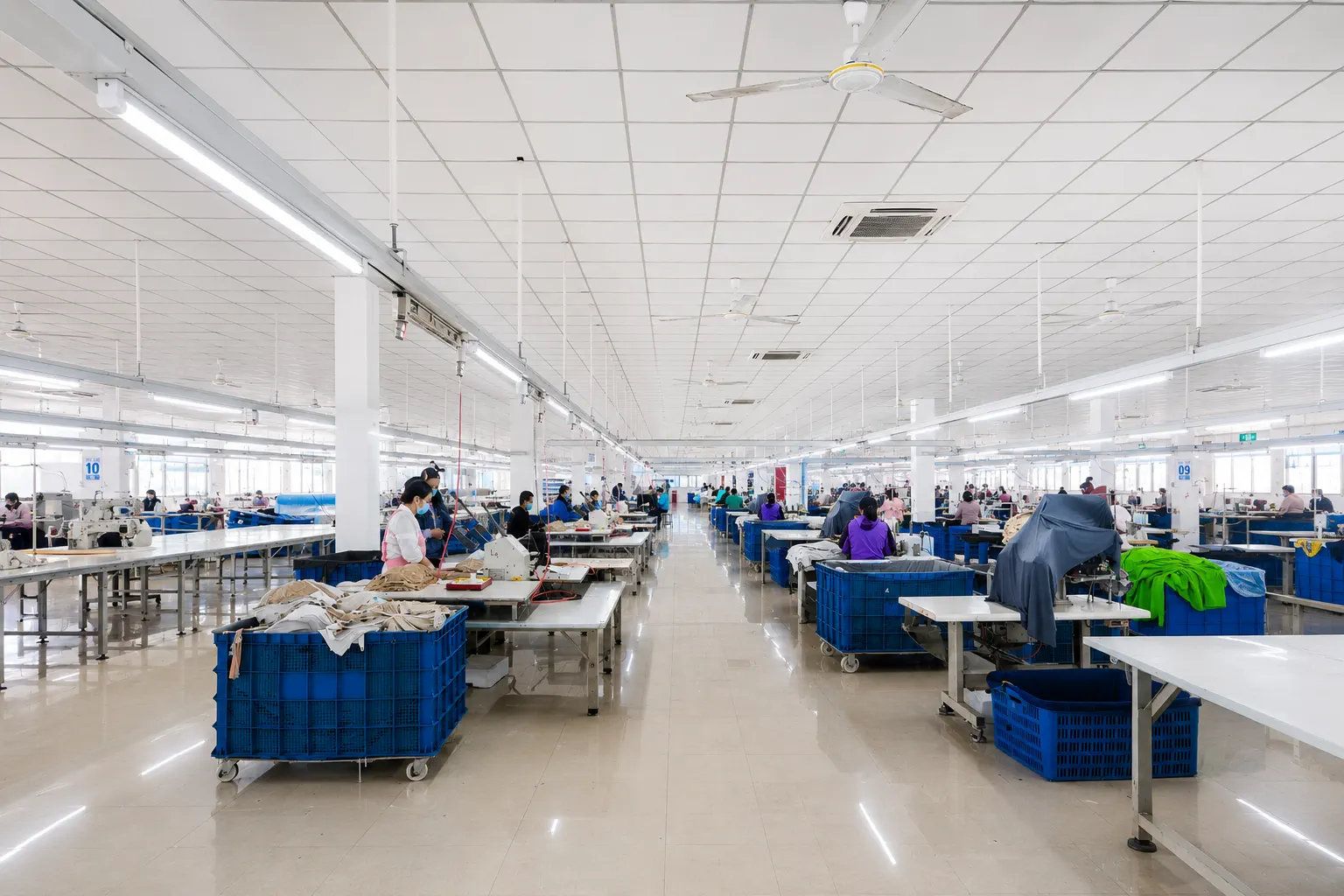
Do not rely on a factory tour, a monthly capacity number or a collection of certificate logos alone.
This guide concerns cut-and-sew technical performance knitwear made from finished knitted fabrics. It does not use sweater-specific indicators such as flat-knitting gauge, linking or fully fashioned construction as substitutes for performance-fabric and garment-sewing evidence.
1. Define the product and risk before comparing suppliers
The appropriate OEM depends on the program. Start with the product category, fabric, intended activity, fit, seam complexity, functional claims, order quantity, target market, testing and delivery requirements.
A supplier that performs well on conventional jerseys may not be the best fit for compression garments, Merino wool base layers, laminated constructions or close-fitting products with low-profile technical seams. Compare suppliers against the same tech pack, material assumptions and quotation basis.
Avoid universal scorecards with arbitrary weights. A product with a sensitive material claim may place traceability above price; a close-fitting base layer may place seam capability and recovery control above monthly line capacity. Set project-specific requirements and separate non-negotiable failures from factors that can be traded off.
2. Verify the legal identity and operating location
Request the contracting company name, registered address, business licence, production-site address, quotation entity, invoice entity, bank beneficiary and proposed exporter. Differences do not automatically indicate a problem, but they must be explained and documented before payment or contracting.
For a supplier registered in China, ask for its Chinese registered name and check the registration details through the National Enterprise Credit Information Publicity System. Compare the record with the business licence and clarify any differences. The European Commission’s China IP Helpdesk guide explains how to use the system. A registry check alone does not establish the actual production site or its manufacturing capability.
Match certificate and audit documents to the correct legal entity, site, product category, operation scope and validity period. A certificate held by a related company, material supplier or another factory should not be presented as evidence for an operation outside its stated scope.
Confirm which site will make the samples and which site will make bulk production. If more than one site may be used, define the approval and change control required before moving production.
3. Map what “vertically integrated” actually means
Vertical integration does not require one company to own fiber production, spinning, yarn dyeing, knitting, dyeing, finishing, printing, garment sewing, testing and logistics. The term is useful only when the actual process map is clear.
Ask the supplier to classify each relevant stage as:
- Owned and operated directly.
- Affiliated but legally separate.
- Regularly subcontracted.
- Nominated by the buyer.
- Purchased as a finished material or service.
Then verify the stages that matter to the program. For a performance-knit garment, this may include finished-fabric development, laboratory testing, cutting, FLATLOCK or ACTIVESEAM construction, OVERLOCK and COVERSTITCH operations, heat transfer, finishing, final inspection and export preparation.
The purpose is not to penalize every external process. It is to identify where technical control, lead-time risk, confidentiality and traceability sit.
4. Test technical capability on the nominated fabric
Equipment lists are a starting point, not proof of a finished result. Request live or recorded evidence showing the relevant machine, operation and current sample. Where model-specific capability matters, verify the machine nameplate and configuration.
For technical seams, assess:
- The proposed stitch type and needle/thread configuration.
- Seam width, allowance and appearance on both faces.
- Thread selection and compatibility with the fabric.
- Seam extension, strength and recovery on the nominated fabric.
- Puckering, skipped stitches, tunnelling, edge stability and bulk.
- Operator consistency through intersections and thickness changes.
- Appearance and function after the required laundering process.
Use a signed construction sample or approved pre-production sample rather than accepting “FLATLOCK” or “ACTIVESEAM” as a complete specification. ACTIVESEAM is a named Merrow platform and should not be used as a generic synonym for any flat-looking seam.
5. Audit finished-fabric and lot control
For cut-and-sew technical knitwear, fabric control often determines garment fit and performance. Review how the OEM controls:
- Supplier and finished-fabric article identity.
- Composition, knit construction, GSM and usable width.
- Stretch and recovery by direction.
- Shade, lot segregation and color approval.
- Dimensional change, spirality, pilling and strength where relevant.
- Functional finishes and the test method behind any performance claim.
- Incoming inspection, roll identification and nonconforming material.
Ask for sample reports from a comparable process, then agree which results must be generated on the actual bulk fabric. Do not assume a generic fabric certificate covers every color, lot, finish or finished garment.
Review the report against your project requirements: the laboratory, sample or fabric lot, test method and version, and results. If the project requires an accredited laboratory, check with the relevant accreditation body that the laboratory is currently accredited and that the required test is within its scope. ILAC explains how accreditation bodies list accredited laboratories and their scopes. Laboratory accreditation does not automatically certify a finished garment.
6. Review the development and approval system
A capable development team should be able to identify ambiguity in the tech pack, propose a construction, record questions and control revisions. Review the workflow from initial feasibility through proto or development sample, fit approval, material approval, size set and pre-production sample as applicable. The OEM knitwear services overview shows how these development stages connect to bulk production, quality control and export shipping.
Check whether comments are incorporated into a controlled specification rather than remaining in chat messages. Confirm who can approve pattern, fabric, construction, color, trim and artwork changes, and what happens if an approved component becomes unavailable.
Sampling speed should not be evaluated without context. A quoted calendar time may exclude fabric development, laboratory dips, nominated trims or buyer comment time. Ask for the assumptions behind the schedule.
7. Verify capacity against the actual bottleneck
A factory-wide monthly capacity number does not show whether the required machine, operator, fabric or finishing slot is available for one program. Request a project-level plan covering:
- Proposed production line or cell.
- Critical sewing and finishing equipment.
- Trained-operator availability.
- Fabric and trim lead time.
- Sample and approval dependencies.
- Cutting, sewing, finishing, inspection and packing dates.
- Planned subcontracting or alternate-site use.
- Recovery plan for late material or rejected production.
Compare capacity with the agreed quantity, color split, size ratio and delivery window. A lower headline capacity with a credible reserved plan may be less risky than a high number without a documented schedule.
8. Examine quality data, not only a final inspection promise
Ask for the quality plan and examples of records that do not reveal another customer's confidential information. Relevant evidence may include incoming material checks, first-piece approval, inline measurement, defect recording, end-line review, testing status, needle control and final inspection.
Agree the defect classification, measurement tolerances, inspection basis, rework process and responsibility for failed testing before issuing the purchase order. If an AQL plan is used, the buyer should define the inspection level and acceptance criteria rather than treating “AQL 2.5” as a complete quality agreement.
Review trends and corrective action where available. A clean sample room does not show how repeated bulk defects are identified, contained and prevented.
9. Check traceability and certification scope
When a program includes a certified-material claim, traceability should connect the input, supplier, lot, production records, quantities and transaction documents. The Textile Exchange Content Claim Standard describes chain-of-custody controls including documentation, volume reconciliation, segregation, scope certificates and transaction certificates.
For GOTS-labelled products, the official GOTS certification guidance states that relevant processors, manufacturers and traders must meet the certification requirements for the final product to carry the label. Verify the current scope and product eligibility rather than relying on a logo in a sales deck.
OEKO-TEX STANDARD 100 addresses testing of textile articles for harmful substances. It does not by itself verify factory ownership, labor conditions, delivery performance or the full environmental profile of an OEM.
An SLCP Converged Assessment Framework report can provide verified social and labor data, but SLCP training materials state that the framework does not create a value judgment or supplier score. The buyer still needs to interpret the data against its own requirements. See the SLCP framework.
For U.S.-bound programs, forced-labor due diligence must use current official information. The DHS UFLPA page explains the rebuttable presumption and links the maintained Entity List. Because the list and enforcement information change, recheck the official source at the time of sourcing and shipment rather than freezing a historical list into a supplier scorecard.
Where wet processing or chemical inputs are relevant, clarify who controls the process and what chemical-management evidence is required. The ZDHC MRSL concerns substances restricted from intentional use in manufacturing inputs; it is different from a finished-product restricted-substances test.
10. Normalize the quotation before comparing price
Send every candidate the same controlled package and request the same quotation basis. Confirm:
- Incoterm and named port or place.
- Quantity per style, color and size assumption.
- Finished-fabric article and included testing.
- Sample, pattern, artwork, tooling and laboratory charges.
- Packaging and labelling.
- Payment schedule.
- Production and material lead-time assumptions.
- Price effect at the quantities the buyer may realistically place.
- Defect, shortage, remake and claim procedure.
A low unit price may omit testing, nominated material, special packaging, freight to port, certification documentation or realistic color splits. Normalize these differences before ranking suppliers.
11. Use a controlled pilot to verify the system
Before scaling a new relationship, use an order or development program large enough to exercise the actual material, construction, documentation and quality workflow. The purpose is to verify the system, not merely receive one perfect sales sample.
Track question resolution, revision control, material approval, schedule accuracy, inline communication, test results, final inspection and shipment documents. Record both failures and how they were corrected. A supplier that identifies a technical risk early may be more dependable than one that accepts every requirement without review.
Red flags that require clarification
- Contract, invoice, bank and certificate entities do not match and no clear explanation is provided.
- The proposed bulk site differs from the sample site without disclosure.
- “Vertically integrated” is used without a process map.
- Equipment photographs cannot be connected to the contracting supplier or production site.
- Certificate scope, site, product or validity cannot be verified.
- Fabric approval is based only on composition and color, without finished-fabric performance controls.
- The quotation changes when realistic color, size, testing or packaging assumptions are added.
- Production starts before the current tech pack, material and pre-production sample are aligned.
- The supplier refuses reasonable third-party inspection or agreed testing.
No single red flag automatically proves that a supplier is unsuitable. It does mean the buyer should resolve the inconsistency before committing money, materials or delivery obligations.
Buyer questions
Common buyer questions
Does vertically integrated mean every process must be owned?
No. It should mean the relevant process relationships and controls are clear. Owned, affiliated, subcontracted, nominated and purchased stages should be identified so the buyer can evaluate technical control and risk.
Is a factory audit enough?
No. An audit may cover a defined social, quality, security or environmental scope at a specific site and time. It does not automatically verify product fit, technical seam capability, fabric performance, capacity allocation or every certification claim.
Should buyers require a specific score before approval?
Not as a universal rule. Set project-specific mandatory requirements and then compare trade-offs. If a numerical score is used internally, document the reason for each weight and do not present the total as an industry standard.
What should be verified first for technical performance knitwear?
Start with the legal and production scope, nominated finished fabric, seam map, sample performance, project-level capacity plan and controlled approval system. These determine whether the supplier can reproduce the intended garment before broader commercial optimization.
Primary sources